
The Long Return of the Crane
An Auria Journal Story.
June 19, 2026
At first light on the Somerset Levels, the water does its quiet work.
It gathers in the low fields and reed-fringed ditches, reflects the pale widening sky, and gives the land back a little of what it once knew. Before drainage, before enclosure, before marsh became something to be managed out of usefulness, this was crane country. Long-legged birds moved through the shallows with priestly patience. Their calls travelled across the wetland, deep and carrying, as much a part of the British soundscape as church bells, wind in willow and cattle shifting behind hedges.
For four centuries, that voice was largely absent, but now it is returning. The news that common cranes have reached a record breeding year in the UK feels, at first, like a simple conservation success story. A species once lost as a breeding bird has come back. Numbers are rising, chicks are fledging, and the UK’s tallest bird, standing over a metre high, is again stepping through reed beds, dancing in spring, and calling across restored wetlands with a sound that can carry for miles.
Then the deeper meaning begins to settle. This is not just the return of a bird, it is the partial repair of a broken relationship between land, water, people and memory.
Cranes were once familiar in Britain. They appear in place names, in old records, in the cultural sediment of marshland communities. Their decline was a human story before it became an ecological one. Wetlands were drained and birds were hunted, and the old abundance was turned into absence, which then became normal. Generations grew up with no expectation of seeing a crane rise from a British reed bed, no memory of its wings lifting slowly into the morning, no childhood association between marsh and magnificence. That is how nature loss often works. It does not always arrive as drama. Sometimes it arrives as forgetting.
The crane’s return began quietly. In 1979, a small number of wild cranes from mainland Europe settled in Norfolk. Their presence was fragile, almost improbable. Cranes breed slowly, choose carefully, and require the kind of wet, protected habitat Britain had spent centuries reducing. For years, their recovery felt tentative and then came the patient work.
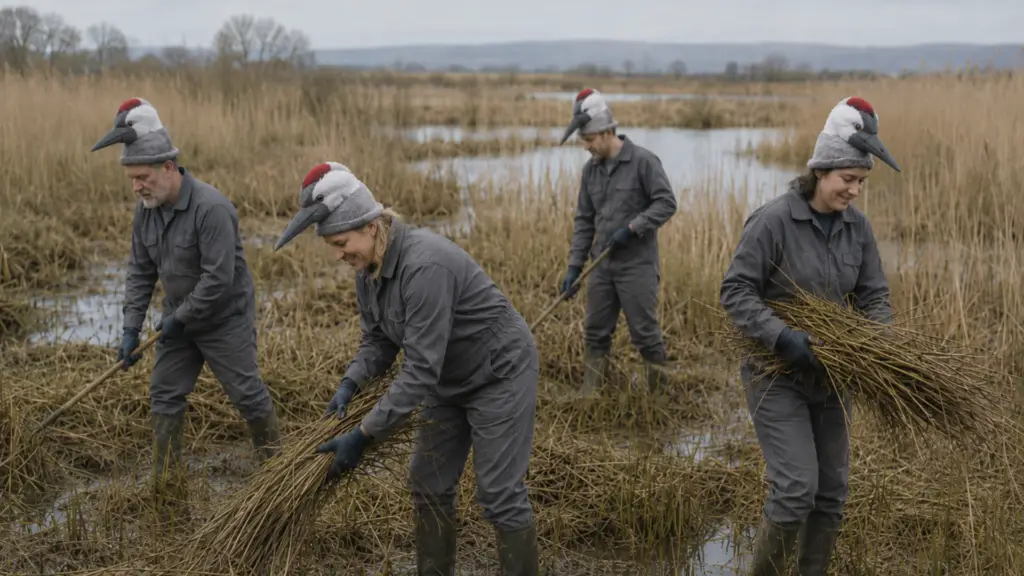
The Great Crane Project, led by conservation partners including the Wildfowl & Wetlands Trust, RSPB and Pensthorpe Conservation Trust, added human intention to natural recolonisation. Eggs were collected under licence from Europe and brought to Slimbridge, where young cranes were hand-reared with extraordinary care. Human carers wore grey outfits and used prosthetic crane heads to avoid imprinting the birds on people. It sounds almost theatrical, until you understand its purpose. These chicks needed to learn the world as cranes, not as human dependants with feathers.
Crane chicks were taught to forage. They were exercised, monitored and protected. They learned alarm calls and the textures of threat and safety. Then, when they were ready, they were released into the Somerset Levels and Moors, where water, reed and careful land management offered them a chance to become wild.
The image is quietly moving: people disguising themselves in order to disappear from the story. Conservation at its best often has this humility, by intervening then stepping back. It builds conditions, then allows nature to take authorship. Then, over time, the cranes began to do what cranes do. They paired and wandered and some settled in Somerset. Others ranged across the rest of Britain. They moved through the Severn Vale, reached Gloucestershire, travelled into Wales and East Anglia, and pushed the edge of possibility northwards. Their recovery has been uneven, closely monitored and still vulnerable, yet it has become one of the most resonant examples of how restoration can work when it is patient, collaborative and landscape-led.
The latest breeding figures give the story its headline. The cranes had a record year, with 87 pairs raising 37 young in 2025, bringing the UK population to around 250 birds. For a species absent for hundreds of years, these numbers carry more than statistical weight.
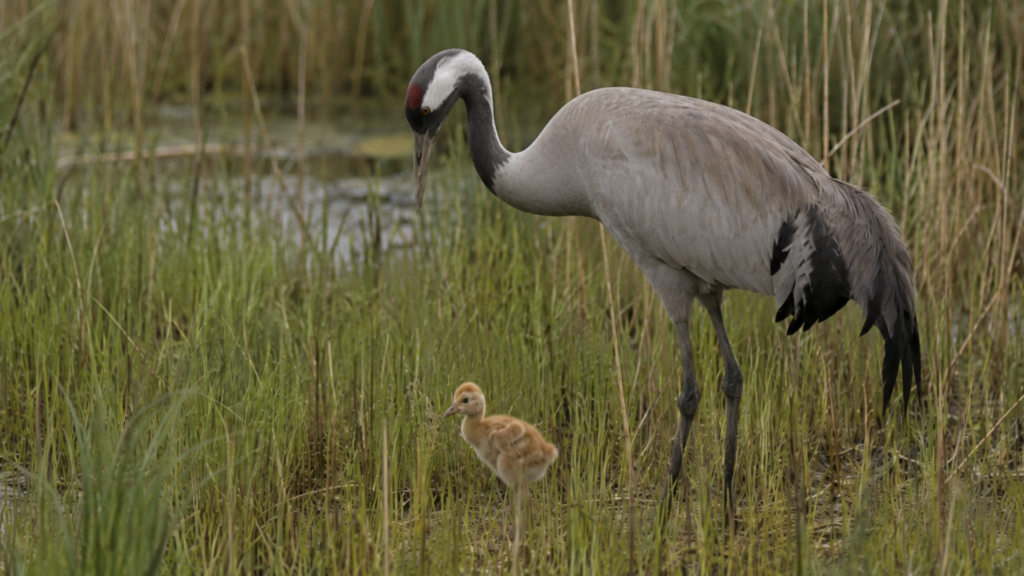
Each chick is a living argument against resignation. A crane chick is not an obvious emblem of triumph. It is awkward, downy, earth-coloured, and urgently dependent on concealment. It cannot carry the symbolic burden we place upon it. Yet perhaps that is why it works so well. Restoration is rarely grand at the beginning. It is small, vulnerable, and easily lost. A chick in a reed bed, a wet field held back from drainage, a farmer agreeing to manage land differently, or a volunteer watching from a distance through a telescope, resisting the desire to come too close.
Much of the crane’s recovery has depended on protected places and quiet human restraint. The birds need wetlands where they can breed away from disturbance and predators. They need reed beds and pools, damp grassland and connected landscapes. They need people who understand that visibility is not the same as success. Some reserves remain closed or carefully managed because the most meaningful wildlife experiences are sometimes the ones we protect by not consuming them.
For Auria Foundation, this is where the crane becomes more than a species profile. It becomes a model of regenerative investment. The return of cranes has required science, fieldcraft, funding, local trust, landowner cooperation, volunteer commitment and long-term habitat restoration. It has required people to work beyond the visible moment of reward. Those who began the reintroduction could not expect immediate success. Cranes often take years to breed, and early attempts may fail. Wetlands take time to recover, communities take time to believe and funders take time to see the living return on ecological patience. Yet this is precisely the kind of work that deserves deeper support.
In a culture drawn to quick outcomes, the crane asks for a longer imagination. It asks us to fund not only emergency rescue, but conditions for continuity. It asks us to see wetlands as more than scenic backdrops. They are nurseries, carbon stores, flood buffers, acoustic landscapes, memory banks and future infrastructure for life.
A restored wetland does not only serve cranes. It supports wading birds, aquatic plants, insects, amphibians, fish, mammals and people living downstream in a climate of heavier rain and greater uncertainty. It slows water, holds carbon and makes space for complexity. The crane may be the visible ambassador, elegant enough to command attention, but the real story is the living system beneath its feet.
There is something deeply British about this particular recovery. Not loud or immediate. Not polished into spectacle, but a little muddy, even a little eccentric in places. Full of volunteer effort, practical compromise, local knowledge and determined optimism. People dressed as cranes so cranes could grow up wild. Farmers helped make room. Conservationists watched, counted and waited. Communities began to recognise the bird as theirs again.
And somewhere, on a winter evening in the Fens or the Somerset Levels, a flock rises. The sound comes first, low and bugling, carrying over reed and water. Then the shapes lift into view, long necks extended, legs trailing behind, wings opening with the slow authority of something ancient returning. For a moment, the distance between past and future narrows. What was lost is not fully restored, but it is present again. Alive, breeding and calling. The crane has come back because people made room for its return.
That may be the quiet lesson of this story. Regeneration is not only about repairing damage. It is about remembering what belongs, then building the conditions in which it can live again. The return of the crane shows what becomes possible when conservation ambition, land stewardship, scientific care and long-term funding move together.
Auria exists to help stories like this reach the people who can support them, amplify them and help them grow. Quiet impact begins in places like these: a reed bed, a restored wetland, a chick hidden in grass, and a call crossing the morning after centuries of silence.
From the Auria Foundation
At Auria, we believe conservation is not only about protection, it’s about restoration and accessibility. About returning what was lost and allowing nature to resume the roles it once played with quiet confidence.
The story of the wild crane is a reminder that wildlife and ecosystem regeneration is possible with commitment and patience.
Through our membership model, 50% of all subscription funds are directed to carefully selected, high-impact initiatives, working at a national scale to restore ecological integrity and long-term resilience.
If this story has stayed with you, then you are already part of its unfolding. And if you feel drawn to step closer, to help support restoration initiatives, you are warmly invited.
Join us.
Be part of what returns.